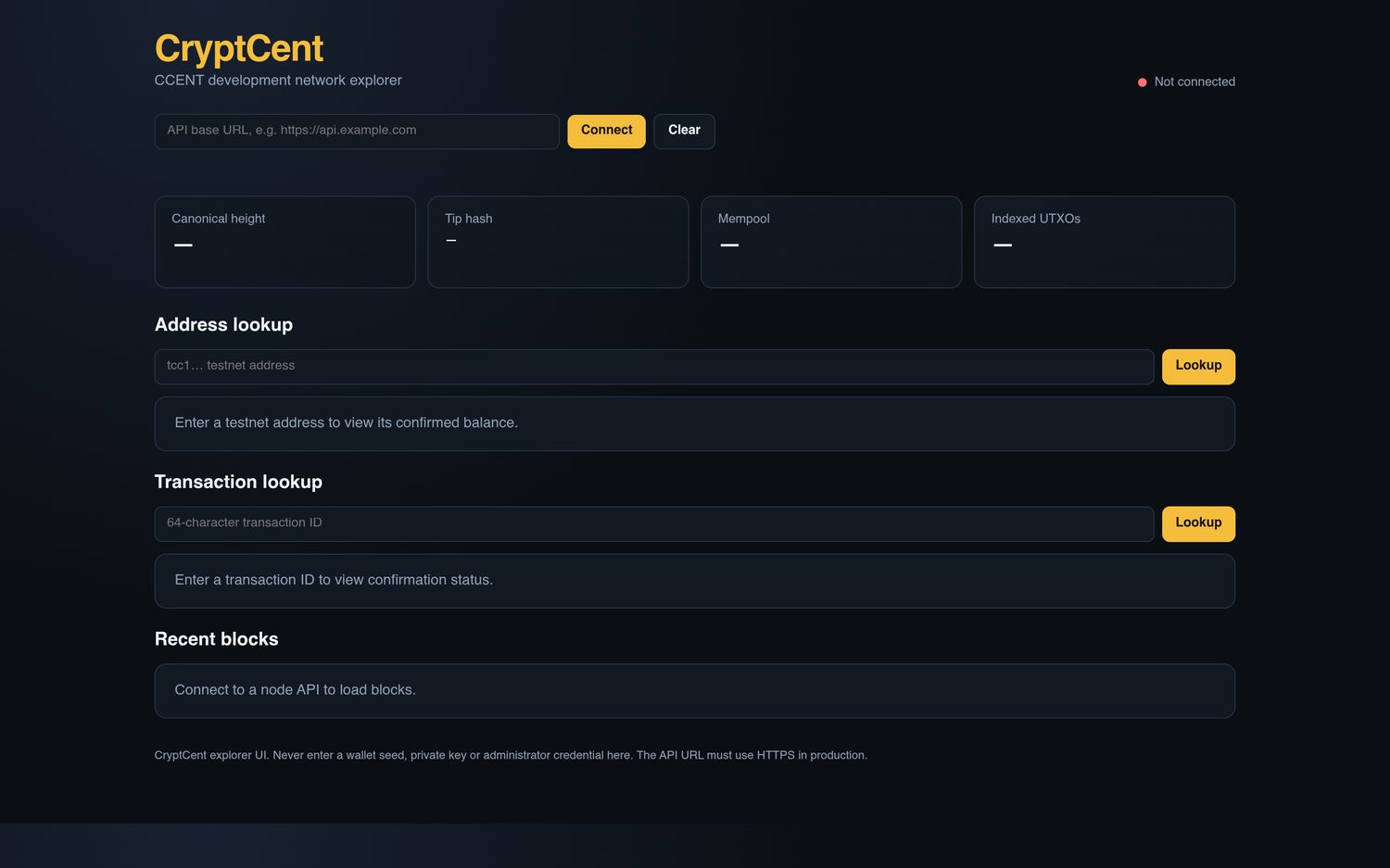
The network explorer — address, transaction and block lookup against the node's own index.
What it is
Most things called a blockchain project are a token contract deployed on somebody else's network. CryptCent is the other kind: an independent, Bitcoin-like project with its own consensus rules, its own binary serialization, its own peer protocol, wallet, miner and explorer, written in Go.
It is a real open-source project under active development, with a draft fixed maximum supply of 30,000,000 CCENT. The work is the part nobody sees from the outside — what a network does when it disagrees with itself.
Not a token on someone else's chain. A chain.
What's in it
A live service with JSON-RPC for status, balances, UTXOs and transactions, plus health and Prometheus-style metrics.
An embedded browser over the chain's own index — blocks, transactions, addresses.
An opt-in, rate-limited testnet faucet for anyone building against the development network.
Key management, address derivation and payment construction against the spendable set.
How it works
Chainwork, not height
Branch selection compares cumulative proof of work, not block count, so a long chain of easy blocks never wins. The hardest code in the repository, and the most heavily tested.
Reorganisations that actually recover
When the canonical chain is rewritten, every transaction detached from the losing branch returns to the mempool rather than vanishing. The whole operation is atomic over durable state.
A mempool with a memory
Bounded, with a fee policy and parent/child transaction support — and it survives a restart. Killing the node mid-write doesn't lose the pending set.
Coinbase maturity in the spendable set
Freshly mined output isn't merely flagged as immature, it's excluded from the spendable set until it matures, so no code path can spend it by accident.
Hostile input assumed
Every decoder is bounded — an unbounded length prefix from a malicious peer is a memory exhaustion attack. Four fuzz harnesses cover block, transaction, frame and address decoding.
Refuses to run unsafely
Binding RPC to a non-loopback address without TLS and a 32-character bearer token file is rejected at startup. An exposed, unauthenticated node is not a configuration worth permitting.
At a glance
Want one of these built for you? Send the brief.